Home » Blog » What Age Should Children Start Swimming Lessons? A 2026 Guide for Singapore Parents

Is It Safe for Newborns to Start Swimming Lessons? What Parents Need to Know First

Determining the ideal age for formal swimming lessons depends on developmental readiness, water experience, and temperament. While infants can begin parent-assisted water acclimation from four months, most children are ready for structured, formal lessons around age four.

In Singapore, early water safety is critical. Selecting an internationally accredited swim school ensures proper progression. With over 25 years of experience, our school is Singapore’s only Gold Standard Tier-1 AUSTSWIM-accredited provider. We understand every child develops uniquely, helping thousands of families successfully navigate their child’s aquatic education and safety journey. 

Key Takeaways

  • Infants can begin water acclimation from four months; structured swimming lessons typically begin at four years
  • Water safety skills reduce child drowning risk, the leading cause of unintentional injury in children under 14
  • Swimming is a developmental milestone with physical, cognitive, and emotional benefits
  • Readiness varies by individual child. Fearless temperament and water comfort matter as much as chronological age
  • Singapore’s premium swim schools offer small-class, competency-based progression rather than age-based advancement

Why Developmental Readiness Matters More Than Age Alone

When should a child learn to swim in any formal capacity? The answer begins with understanding that age is a guideline, not a rigid rule. Developmental readiness encompasses physical coordination, emotional maturity, and breath control. All of these emerge on individual timelines.

Physical development happens gradually. Your child needs sufficient neck and core strength to support their head above water. This typically develops between four and six months. Lung capacity and controlled breath holding develop between three and four years. This matters critically for water safety. Gross motor coordination for basic propulsion emerges around four to five years.

Emotional readiness is equally important. Fear of water is completely normal in young children. Gradual acclimation works better than forcing exposure. Your child also needs to follow basic instructions and show some self-awareness about their environment. Here’s something parents often overlook: your own comfort with water influences your child. If you’re anxious in the pool, your child senses this and mirrors that anxiety.

Competency-based progression frameworks honour this variation. Rather than moving children through levels on a fixed schedule, quality swim schools assess what each child can actually do. Age becomes irrelevant. Only demonstrated competency matters.

Swimming Lessons for Toddlers: Starting Early

Swimming lessons for toddlers aren’t about technique. They’re about building water confidence and safety awareness in a playful, supportive environment.

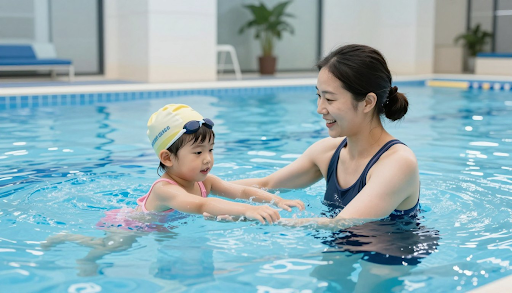
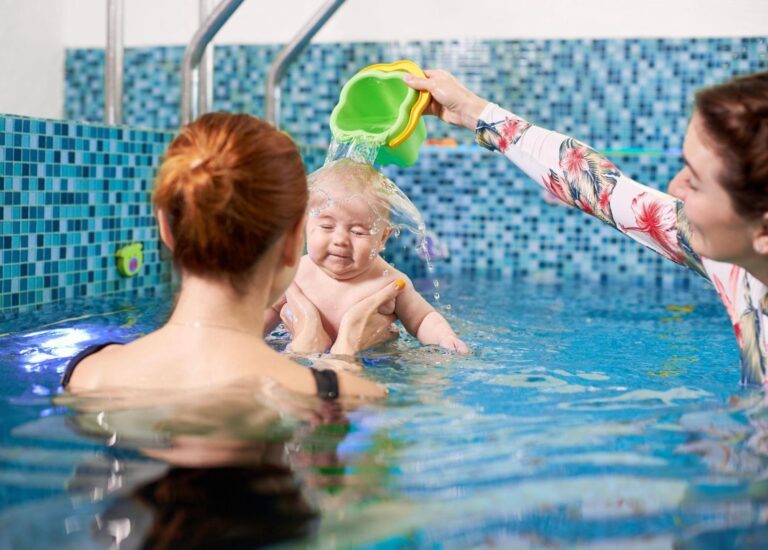
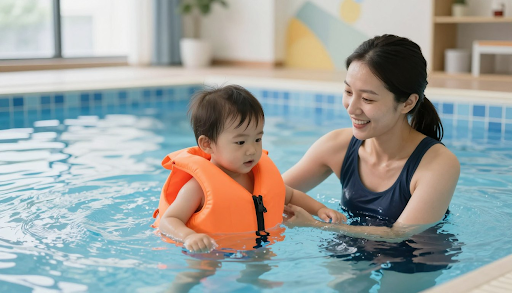
Infant and toddler programmes run from four months to three years. These are fundamentally different from lessons for older children. Your child learns comfort with water immersion and splashing. They develop breath awareness and understand how water feels. They practise floating with adult support. Early water safety concepts become normal rather than frightening. Parent-child bonding happens naturally in a structured setting.

These early experiences normalise water. Children who spend time in water from a young age develop less anxiety about it later. They understand water’s properties. Water holds you up. You can breathe when your mouth is clear. These realisations happen before fear takes root.

Parent involvement is essential at this stage. You’ll be in the water with your child, providing physical support and emotional reassurance. This isn’t passive supervision. You’re actively helping your child explore a new environment safely.

Temperature matters significantly for young infants. Heated pools reduce thermal stress and keep babies comfortable during longer sessions. This allows for more effective learning rather than distraction from discomfort.

Signs Your Toddler Is Ready to Start

Your toddler shows readiness when they:

  1. Display curiosity about water (reaching, splashing, wanting to explore)
  2. Tolerate water on their face without panic
  3. Enjoy bath time without excessive distress
  4. Can sit upright with minimal support

Your own readiness matters equally. You’ll need comfort being in the water regularly and commitment to consistent attendance.

When Should a Child Learn to Swim? The Four-Year Threshold Explained

At what age should children start swimming lessons in a formal, structured setting? Four years emerges as the optimal starting point for most children. Some advanced toddlers begin earlier. Delayed starters can start anytime. No child loses opportunity by waiting.

At four years old, most children have developed sufficient breath control to learn breathing techniques. They’ve developed body awareness to understand floating and propulsion. Cognitive capacity to follow multi-step instructions becomes reliable. Emotional resilience to manage separation from parents typically appears. The ability to engage with instructors other than parents develops naturally.

This doesn’t mean all four-year-olds are ready. Some mature younger. Others benefit from waiting until five or six. The key is honest assessment during a trial lesson with a qualified instructor who can evaluate your specific child fairly.

Children’s Swimming Milestones: What to Expect

Children’s swimming milestones follow a logical progression, though timing varies considerably. Here’s what competency-based advancement looks like in reality.

Level

Age Range

Skills

Timeline

Starfish (Level 1)

4-5 years

Water comfort, floating with support, 5-metre distances

4-12 weeks

Seahorse (Level 2)

4-6 years

Independent water confidence, breath awareness

4-8 weeks

Stingray (Level 3)

5-7 years

Basic propulsion, submersion control, 10-metre swimming

6-12 weeks

Turtle (Level 4)

6-8 years

Independent floating, 10-25 metres, safety awareness

8-16 weeks

Seal (Level 5)

7-9 years

Freestyle and backstroke, safety rolls, and increased distance

12-20 weeks

Dolphin (Level 6)

8-10 years

Extended freestyle, stroke refinement, endurance

Ongoing

Notice the overlapping age ranges. A fearless five-year-old might reach Turtle level in three months. A cautious seven-year-old might take six months. Both are progressing normally. Competency matters; never age.

Movement through levels depends on mastering specific skills. Can they float independently for 30 seconds? Do they control their breathing consistently? Can they swim 25 metres with proper technique? Do they demonstrate water safety awareness? When your child achieves these competencies, they advance. Age becomes irrelevant.

Benefits of Swimming Lessons for Kids: Physical, Emotional, and Developmental Gains

The benefits of swimming lessons for kids extend far beyond knowing how to swim. This is about developing confidence, resilience, and lifelong healthy habits that serve them throughout life.

Physical Development and Water Safety

Swimming builds strength and coordination simultaneously. Your child develops upper-body and core strength from propulsion. Lower leg and foot flexibility improves naturally. Cardiovascular fitness increases without joint stress, because water supports body weight. Motor control and body awareness sharpen noticeably. Enhanced balance and coordination become obvious.

Most importantly, water safety for children reduces the leading cause of unintentional injury for young children. Drowning happens silently and rapidly, sometimes in less than two minutes. There are no warning signs. Children who’ve had structured water safety training understand how to breathe properly in water. They know what to do if they go underwater unexpectedly. They learn floating techniques for survival. They understand when to ask for adult help and respect water hazards genuinely.

Swimming lessons aren’t a guarantee against drowning. Supervision remains essential always. But they’re a proven primary prevention strategy that genuinely saves lives.

Emotional and Cognitive Growth

Beyond physical skills, swimming develops character profoundly. Children who progress through structured levels learn confidence from achieving milestones. Moving from Starfish to Seahorse feels like climbing Mount Everest at five years old. Resilience develops when something doesn’t work the first time. Self-efficacy grows through practice and persistence. Focus and listening improve in a structured group environment. Emotional regulation strengthens through manageable challenges.

Children celebrate tiny victories in swimming. Learning to float independently at five feels enormous. Your child learns that practice works. Mistakes become learning opportunities rather than failures. They discover they’re capable of more than they imagined.

Long-Term Lifestyle Benefits

Swimming becomes a lifelong activity. Your child can enjoy it for fitness, recreation, stress relief, or competition. The discipline and goal-setting mindset transfers to other areas of life naturally. The social connection through squad training builds genuine friendships. The habit of physical activity established in young often persists into adulthood, supporting long-term health.

Water Safety for Children: The Critical Foundation

Water safety for children isn’t an optional add-on to swimming lessons. It’s the foundation of quality instruction from day one.

Drowning is the leading cause of unintentional injury death for children aged one to 14 globally. It’s silent. There’s no splashing or crying for help. It happens in seconds in any depth of water, including bathtubs and buckets. This reality makes structured water safety training essential for every child.

Quality swim schools integrate safety into every single lesson from the very first day:

  1. Breath awareness – Your child learns to exhale underwater and inhale above water, establishing the foundation for survival
  2. Floatation skills – Understanding how water supports them, practising survival float positions consistently
  3. Hazard recognition – Learning to identify pool edges, understand depth changes, and respect water hazards
  4. Listening skills – Following adult instructions quickly and without question in water environments
  5. Personal limits – Knowing their ability level and when to ask for help from trained adults

An AUSTSWIM-accredited school teaches these fundamentals systematically. Every coach holds international certifications, including CPR and life-saving qualifications. Water safety isn’t discussed in theory. It’s practised every lesson as standard practice.

Practical Factors When Deciding When to Enrol Your Child

Beyond developmental readiness, practical considerations affect enrolment timing significantly.

Commitment capacity matters considerably. Swimming lessons require weekly consistency, ideally year-round. Sporadic attendance disrupts progression and skill retention. Can your family commit to weekly lessons for at least 12 months realistically?

Your child’s temperament influences timing meaningfully. A naturally confident, water-loving child might thrive at three. A cautious, anxious child might benefit from waiting until five or six. There’s no rush. Early starters don’t retain advantages years later.

Facility quality directly impacts learning outcomes. Heated, covered pools benefit younger children. Experienced instructors trained in child psychology matter enormously for managing fear. Small class sizes, ideally with a maximum of five children per class, allow individualised attention that large groups cannot provide.

Location matters for busy families. Singapore’s geographic spread means proximity affects consistency. Marsden operates four locations: Bukit Timah near Beauty World MRT, Potong Pasir, German European School Singapore at Dairy Farm Lane (strong for expat families), and Delta Swimming Complex at Tiong Bahru. Choose a location you can reach reliably weekly.

Trial lesson assessment should be non-negotiable. A quality swim school will evaluate your child individually during a trial lesson. They’ll determine appropriate level placement rather than enforcing age cutoffs. They’ll discuss your child’s water experience, temperament, and readiness honestly.

Questions to Ask Any Swim School

Before enrolling, ask these essential questions:

  1. Are all coaches internationally accredited (AUSTSWIM, ASCTA minimum)?
  2. What is your competency-based progression system exactly?
  3. What is your actual maximum class size?
  4. How is water safety integrated into every lesson?
  5. Can my child do a trial lesson for level assessment?
  6. How do you support anxious children or those with previous negative experiences?
  7. What’s your absence and make-up policy?

Frequently Asked Questions

1Can my three-year-old start swimming lessons for toddlers, or should we wait until four?

Many three-year-olds are developmentally ready, especially with prior water exposure. A quality swim school assesses your child individually during a trial class rather than enforcing age cutoffs. Competency-based frameworks accommodate advanced younger swimmers and later starters equally. If your three-year-old shows strong water comfort and emotional maturity, they might begin formal lessons. If they're anxious or still developing coordination, waiting is perfectly reasonable and sometimes better.

2How long does it take for a child to learn to swim?

This depends entirely on your definition of "swim" and your child's starting point. Water confidence and basic floating take four to eight weeks. Independent 25-metre freestyle swimming typically takes three to six months of weekly lessons. Competency-based programmes advance children only when they've mastered each level, never on a fixed timeline. Your child's individual pace is normal.

3Are swimming lessons worth the cost for young children?

If you prioritise water safety, long-term fitness habits, and emotional development, quality swimming lessons are a worthwhile investment. Cheaper bulk lessons at community pools often feature larger classes and less individualised attention. Premium schools employ accredited coaches, maintain smaller groups, and use structured progression frameworks. Cost reflects genuine quality and safety standards that protect your child's well-being.

Ready to Start Your Child's Swimming Journey?

The right age to start swimming lessons depends on your individual child’s readiness, not an arbitrary number. At what age should children start swimming lessons? The answer is personal to every family. Whether you’re considering swimming lessons for toddlers or enrolling a four-year-old in formal training, the most important factor is choosing a school prioritising water safety, individualised attention, and competency-based progression.

At Marsden Swim School, we’ve guided over 25 years of Singapore families through this decision. Our status as Singapore’s only Gold Standard Tier-1 AUSTSWIM-accredited school and our small-class commitment mean your child receives the expertise and personalised attention they deserve. 

Book a Trial Class at Marsden Now 

📧 admin@marsdenswimschool.com

📱Phone: 6015 0637

📍 Main Address: 102 Jalan Jurong Kechil, Singapore 598602

🕐 Operating Hours: Monday to Sunday, 10am – 6pm

🌐 Website: https://marsdenswimschool.com