
Why Some Children Learn to Swim Faster Than Others: 8 Factors Parents Should Know
Many parents wonder why some children learn to swim faster than others, especially when siblings or classmates seem to progress at completely different speeds. The short answer is that swimming ability is shaped by a mix of physical development, temperament, water exposure, and teaching approach, not by natural talent alone. No two children arrive in the pool with the same starting point, and that is entirely normal.
Understanding these factors affecting swimming skills helps parents support their child with patience rather than pressure, and it explains why comparing children to one another rarely tells the full story.
Key Takeaways
- Swimming progress for beginners depends on comfort, coordination, practice consistency, and teaching style, not age alone
- Children can begin building swimming confidence from as young as four months, with progress happening at their own pace
- Water safety skills develop gradually through repeated, positive exposure rather than through a fixed checklist
What Determines Swimming Progress for Beginners
Every child follows a different path in the water. Some factors are physical, such as coordination and body awareness. Others are emotional, such as confidence and temperament. A few depend entirely on the learning environment, including how often a child practises and who is teaching them.
The eight factors below cover the most common reasons children progress differently, and what parents can do to support steady, confident learning at their own pace.
1. Comfort in the Water Shapes Early Swimming Confidence for Children
A child’s first experiences in water often set the tone for everything that follows. Children who feel relaxed and safe tend to explore movement more freely, while children who feel unsettled may take longer to loosen up.
This is not a sign of ability. It is simply a starting point. At Marsden Swim School, children begin their journey from four months old, using this early stage to build familiarity and curiosity in the water rather than to meet any particular milestone. Comfort is built gradually, through gentle, repeated, positive exposure, and every child moves through this stage differently.
2. Frequency of Practice Is One of the Key Factors Affecting Swimming Skills

Consistency plays a significant role in swimming progress for beginners. Children who attend lessons regularly tend to build on previous sessions more smoothly, because skills are reinforced before they have a chance to fade.
Irregular attendance can mean a child spends part of each lesson simply reacquainting themselves with the water, rather than building new skills. This is one of the simplest and most controllable factors affecting swimming skills, and it applies to swimmers of any age.
A few practical habits that support consistency:
- Attending scheduled lessons as regularly as possible
- Encouraging relaxed, low-pressure water play between lessons where appropriate
- Keeping communication open with your child’s coach about how they are settling in
3. Individual Physical Development and Motor Coordination
Children develop coordination, balance, and body awareness at different rates. This is a natural part of growing up, and it directly affects how quickly a child can string together the separate movements involved in swimming, such as breathing, kicking, and arm coordination.
A child who finds it easy to coordinate movements on land may find some swimming skills come together more quickly in the pool, while another child may need more repetition to link the same movements smoothly. Neither pattern reflects how well a child will eventually swim.
4. The Role of a Structured, Competency-Based Framework
Rather than moving children through fixed stages based on age, a competency-based framework allows each child to progress once they have genuinely mastered the skills required, not simply because time has passed. This approach supports steadier, more confident swimming progress for beginners, because no child is rushed ahead before they are ready or held back once they have mastered a skill.
At Marsden Swim School, this framework begins at four months and continues through a series of named levels. The four parent-accompanied levels are:
|
Level |
Name |
Age Range |
|
1 |
Starfish |
4–15 months |
|
2 |
Seahorse |
15 months–3 years |
|
3 |
Stingray |
2.5–3.5 years |
|
4 |
Turtle |
3–4 years |
Children move into independent classes from age 4, entering through Otter as a new starter or Seal if progressing from Turtle, always progressing based on mastery rather than a fixed timetable.
5. Parent Involvement Supports Swimming Confidence for Children
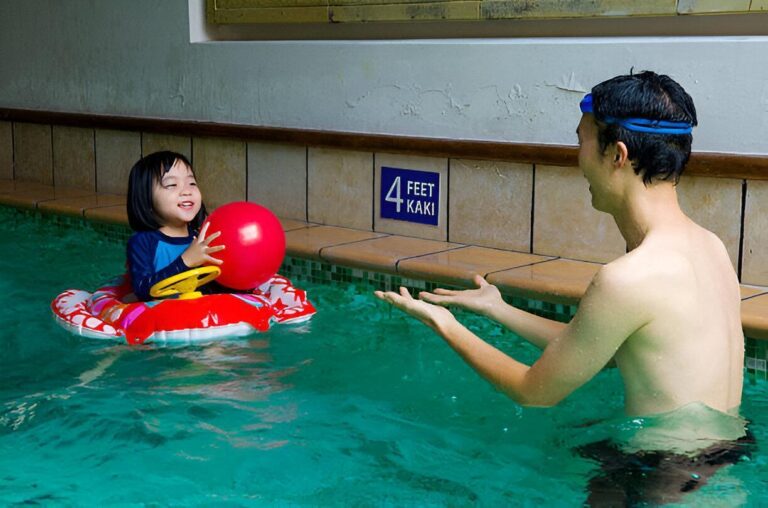
In the early parent-accompanied levels, having a parent in the water alongside their child provides reassurance that a coach alone cannot replicate. This closeness builds trust in the water, which in turn helps children grow more confident as they move through each stage.
Parent involvement is one of the more understated factors affecting swimming skills, particularly for younger children who are still learning to separate the comfort of a caregiver’s presence from confidence in their own ability.
6. Coach Expertise and Teaching Style Influence Progress
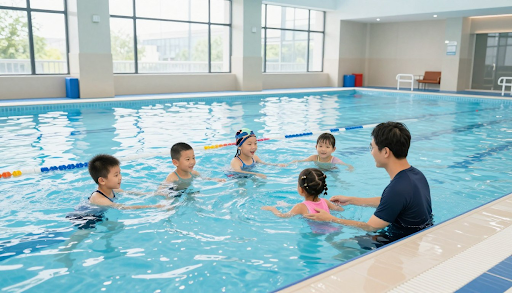
Small class sizes make this kind of individual attention possible. With fewer children per coach, each swimmer gets more direct feedback and a pace suited to their own progress, rather than being carried along by the group. Some children learn best by watching a skill demonstrated several times. Others need to attempt it themselves before it clicks. A skilled coach, supported by a smaller class, recognises which approach suits a particular child and adapts the lesson accordingly.
7. Emotional Temperament and Personality
Some children approach new experiences with immediate enthusiasm, while others prefer to observe before joining in. Cautious children are not behind. They are simply processing a new environment in their own way, and this often means their swimming confidence builds more gradually but just as securely.
Recognising and respecting this difference, rather than encouraging a child to “catch up” to more confident peers, tends to produce calmer, more lasting progress in the water.
8. Water Safety Skills Build Naturally Through Repeated, Positive Exposure
Water safety skills are not a single lesson or a box to tick. They develop cumulatively, through repeated exposure to the water in a calm, supportive setting. A child who has had consistent, positive experiences in the pool tends to respond more calmly if they unexpectedly find themselves in deeper water or off balance.
This is one of the clearest reasons why comparing children directly can be misleading. A child with more consistent water exposure will often appear more confident, regardless of how naturally coordinated they are.
How Long Does It Take a Child to Learn Swimming
There is no single answer to how long it takes a child to learn swimming, because every child brings a different combination of the factors above. Rather than expecting a fixed outcome, it is more useful to focus on steady, consistent exposure and trust that each child will progress at their own pace, supported by a structured, competency-based approach.
Frequently Asked Questions
Differences come down to a mix of coordination, water comfort, consistency of practice, temperament, and the teaching approach used, rather than natural ability alone.
Children can begin building water confidence from as young as four months old, using this early stage to develop comfort and curiosity in the water at their own pace.
Yes. Consistent, regular exposure to the water tends to support steadier progress than irregular or occasional sessions, regardless of a child’s starting point.
Ready to Support Your Child’s Swimming Journey
Every child’s path in the water looks a little different, and that is exactly how it should be. If you’d like to see how a structured, competency-based approach and small, personalised classes can support your child’s swimming confidence and water safety skills, we’d love to have you visit.
Families exploring where to begin often start with our Infant and Toddler Swimming programme or our swimming classes for kids, both designed around the same principle: progress at a pace that suits your child.
Book a Trial Class at Marsden Now
📱Phone: 6015 0637
🕐 Operating Hours: Monday to Friday (9am to 6pm), Saturday and Sunday (8am to 6pm)
🌐 Website: https://marsdenswimschool.com